

This Whale Watch Room Gallery Exhibit, “The Light on the Edge of Darkness,” features photographs by Scott Sewell; opening reception on June 13, 2026, at 5 p.m. The exhibit will remain on display from 6/13 through 9/7/2026. Jewelry by Ling-Yen Jones continues to be on display.
Bio:
Scott Sewell is an award-winning landscape photographer specializing in Coastal California, the High Sierra, and travel photography. Drawn to the raw beauty of rocks, waves, clouds, and their moods and textures, he works in both black & white and in color. He has also been known to shoot cityscapes, wildlife, and people. A fourth-generation Californian with a deep love of the western outdoors and the photography of Ansel Adams, he has spent much of the past decade exploring the Mendocino Coast, the Eastern Sierra, and traveling abroad in search of images. Whether on foot, horseback, or 4×4, his intimate connection to the land informs his photography, creating art that captures the spirit of these places.
A former IT professional, Scott shoots with two Z7II Nikon cameras and meticulously edits his work using the tools of the modern digital darkroom. He produces matted prints from his own 12-color printer and metal prints created by Bay Photo in Scott’s Valley, CA, to his specifications. His greeting cards are printed individually on his Canon printers.
His photographs are available for purchase at the Point Arena Lighthouse, Coast Highway Artists Collective, and during his exhibitions and shows on the Mendocino Coast. His complete portfolio and online store can be found at scottsewellphotography.com. Custom orders welcome.
Scott divides his time between Fort Bragg, CA, the Sierra Nevada, Marina del Rey, CA, and international destinations, traveling with his wife, June, without whom he would not be possible.
Artist Statement –
I don’t remember when I saw Point Arena Lighthouse for the first time. We passed through the area on family vacations several times in my childhood, but I have no specific recollection of it. When I was 19, my brother and I drove south along Highway 1 late at night, and I do remember the flash of the light in the distance as we crossed over the Garcia River. The tower itself was only vaguely visible, but the tremendous reach of the lens was apparent in the light fog.
When I returned to the area in 2017, I was looking for cliffs and crashing waves as a subject for my newly sharpened photography skills. While I remembered the coastline, I did not remember the tall, cylindrical Lighthouse that guarded it.
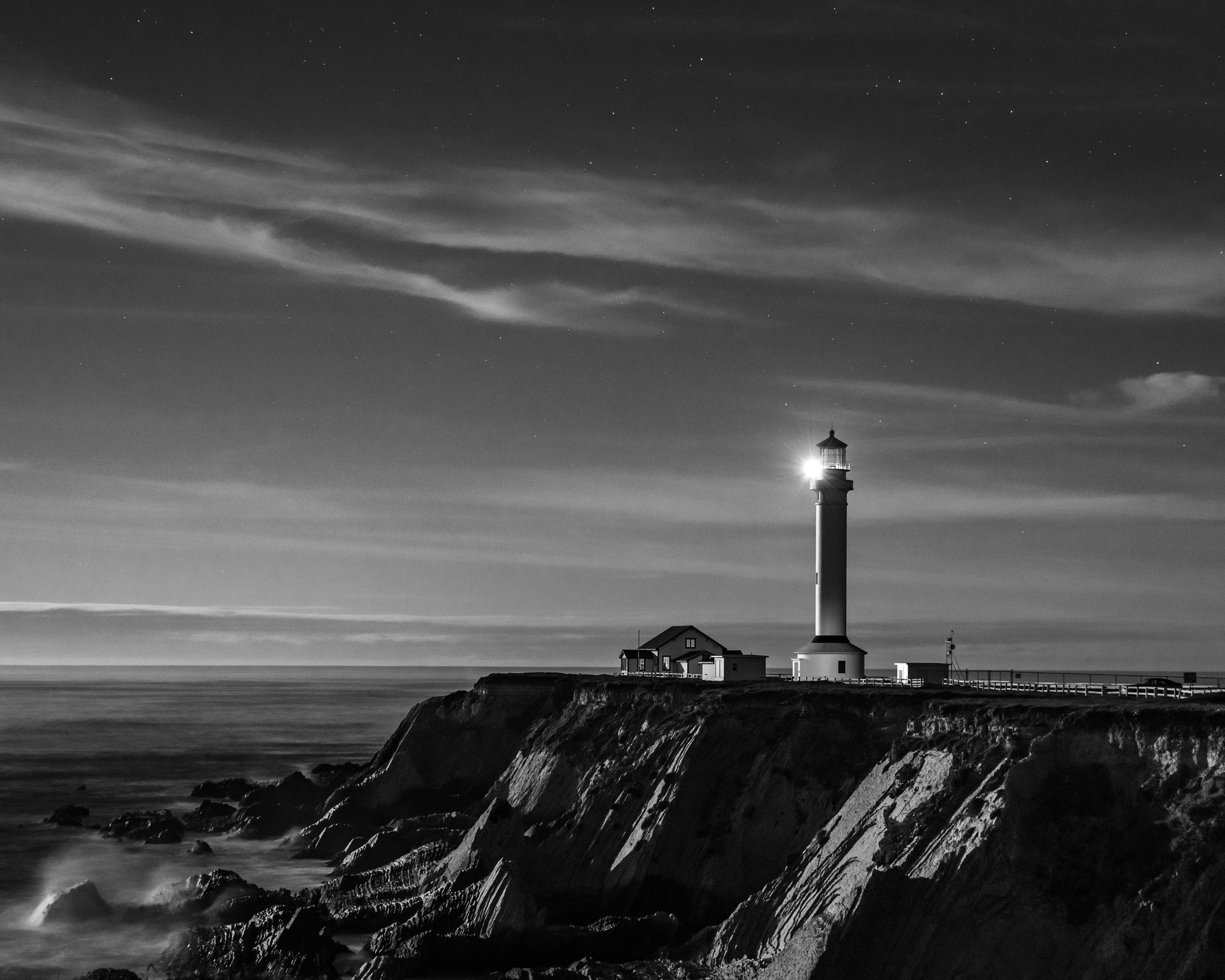
When I got there, I was fascinated. The tower looked different than any other lighthouse I had ever seen. It was more like a giant candlestick than the conical shape I was familiar with. It was built in 1870 and had a twin in Santa Cruz at Pigeon Point. I soon learned that it was a cast concrete rebuilt from its original design after the great San Francisco earthquake of 1906. Its lantern room and the spiral staircase leading to it were its only original equipment. Its great first order lens was replaced due to the mercury in its rotating base some years later, and the light’s reach was thirty miles when it was built, but now was only 10 miles.
As I explored the area looking for places to shoot, it became clear why the Lighthouse was there. The ancient sandstone layers that make up the local sea bottom and the nearby cliffs have been tilted upward by plate movements over the last 20 million years to form reefs with razor-sharp edges. This is easily seen on a walk from the Stornetta lands parking area to the Lighthouse. At the end of Point Arena, the most dangerous reef of all can be seen about a mile offshore, as turbulence and wave action just below the surface. Ships seeking refuge in Manchester Bay to the north would run aground here, and the Lighthouse was placed here to warn them.
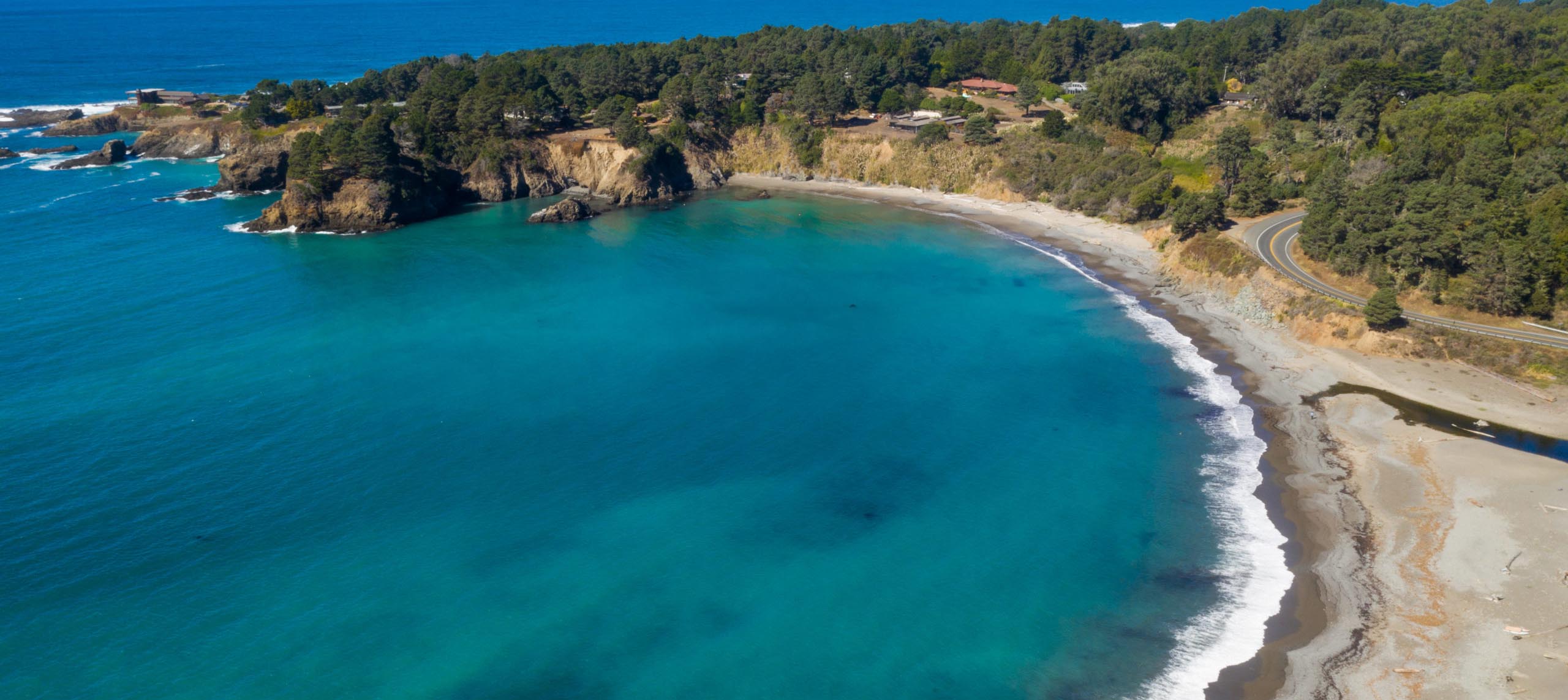
For a photographer, the angles and views are endless. The Lighthouse can be shot from the south on fingers of land in Stornetta; from the point itself; from the hill along the Garcia River; and from the beaches of Manchester to the north. Over time, I have shot from them all. Of course, the Mendocino Coast is famous for its sunsets with its colorful skies in shades of red and orange. This often provides a dramatic backdrop for my photography.
For me, though, it is in the night under a full moon with the ground lights illuminating the tower that has the deepest meaning. There, the Point Arena Lighthouse stands against the wind, the stars, and the raging surf as a sentinel against the 4,500 miles of ocean to the west. It gives me pause and time to reflect. It is then that it truly feels like the light on the edge of darkness.